My Favorite Twirler Calls Me Mom: A Designer Review
When evaluating digital assets for a craft business, the transition from screen to stitch is where the real test begins. As a designer who regularly produces custom apparel and personalized gifts, I approach every new graphic with a critical eye toward production viability. My Favorite Twirler Calls Me Mom is a sentiment-heavy design that targets a specific niche of dance moms and supporters, but its success in embroidery depends entirely on how well the vector lines translate into thread paths. Having reviewed the provided print-ready files, including the SVG, PNG, DXF, AI, and EPS formats, I want to share my practical assessment of using this artwork for real-world embroidery projects.
Visual Personality and Emotional Resonance
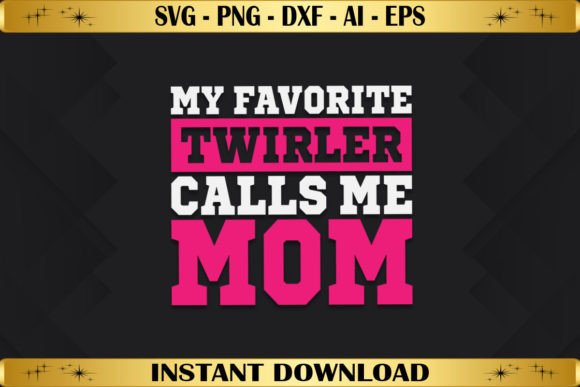
The first impression of My Favorite Twirler Calls Me Mom is one of nostalgic pride. In the Crafts category, designs that evoke specific family roles often outperform generic graphics because they tell a story. Visually, the layout suggests a balance between playful typography and illustrative elements typical of baton twirling or dance motifs. For an Etsy seller or boutique owner, this emotional hook is vital. Customers aren't just buying a shirt; they are buying recognition of their identity as a supportive parent.
From a design hierarchy perspective, the phrase centers the relationship ("Mom") while establishing the child's passion ("Twirler"). This makes it an excellent candidate for personalized gifts where the recipient needs to feel seen. However, as a reviewer, I look beyond the sentiment to the line weight. The vectors appear clean, which is promising for digitizing, but the complexity of any script font or baton details will dictate whether this works best as a direct machine embroidery design or if it requires modification for smaller applications.
Real-World Application: The Custom Sweatshirt Test
To truly judge this asset, I mentally placed it in a production scenario: creating a custom crewneck sweatshirt for a dance recital. Sweatshirts are a staple for small shop products, but the fleece texture presents challenges. When applying My Favorite Twirler Calls Me Mom to this substrate, the primary concern is clarity against fabric pile.
If you are planning sweatshirt embroidery, the design’s open areas are actually beneficial. Unlike dense fill stitch patterns that can cause puckering on stretchy fleece, a design with balanced negative space allows the garment to drape naturally. I envision this working beautifully as a left-chest placement or a centered back print. For the chest placement, you would likely utilize a combination of satin stitch for the lettering and perhaps a running stitch for finer baton details. The key here is ensuring the text remains legible from a conversational distance. If the script is too thin, it risks getting lost in the fabric texture; if it is too thick, it becomes a stiff armor plate on the chest.
For tote bag design, this graphic offers more versatility. Canvas provides a stable foundation that handles higher stitch density without distortion. A tote bag allows you to scale My Favorite Twirler Calls Me Mom larger, showcasing intricate details that might be impossible on a baby onesie or cap. This makes the tote version ideal for commercial embroidery aimed at competition days, where moms need to carry gear and display team spirit simultaneously.
Technical Considerations for Embroidery Success
While the included digital embroidery file formats (SVG, DXF, EPS) are excellent starting points for digitizing software, they are not stitch files themselves. You must verify specific parameters before running a production batch. Here are my technical notes for adapting this Graphics asset into a flawless finished product:
- Hoop Size Verification: Always confirm your machine’s maximum stitching area matches the design dimensions. If resizing My Favorite Twirler Calls Me Mom down for a baby embroidery project, check that the smallest letters remain above 4mm in height to prevent thread breaks and illegibility.
- Stabilizer Selection: For knit fabrics like t-shirts or sweatshirts, use a cut-away stabilizer to support the weight of the stitches. For woven items like aprons or tea towels, a tear-away may suffice, but only if the design lacks heavy fill areas.
- Fabric Texture Contrast: Test this design on both light and dark backgrounds. If the baton or figure details rely on fine lines, they may disappear on dark fabric unless you add a white underlay or outline. High contrast is non-negotiable for professional results.
- Thread Color Strategy: Since this is a "print ready" graphic, it may contain gradients or shading that do not translate directly to thread. Simplify the color palette to 3-5 solid thread colors for optimal production speed and visual clarity.
Navigating Limitations and Risk Areas
No design is universal. There are specific scenarios where I would advise caution when using My Favorite Twirler Calls Me Mom. Curved surfaces, such as caps or hats, require significant distortion correction. If the original artwork has straight horizontal baselines, wrapping it around a cap without digitizing adjustments will result in crooked text. Unless you have advanced digitizing skills or a pre-digitized hat version, stick to flat surfaces like pillow covers, blankets, or patches.
Additionally, be wary of tiny decorative accents. If the design includes small stars, sparkles, or thin baton shafts, these elements can become problematic on textured fabrics. In such cases, consider removing those micro-details or converting them to simple tack-down stitches within an applique design structure. Applique is often superior for large holiday embroidery projects because it reduces stitch count while maintaining bold visual impact.
For Etsy sellers offering printable mockups or digital downloads, ensure your listing photos accurately represent the limitations of embroidery. Do not show a digitally rendered gradient if the physical stitch-out will be solid blocks of color. Managing customer expectations regarding handmade product variations builds trust and reduces returns. Transparency about what is achievable with thread versus ink is the mark of a professional creative entrepreneur.
Professional Workflow and Licensing Checks
Before adding My Favorite Twirler Calls Me Mom to your permanent library of design assets, conduct a thorough workflow check. Download the zip folder and organize the SVG, PNG, DXF, AI, and EPS files into your project directory. Even though these are vector-based, always perform a test stitch-out on scrap fabric identical to your final product. This step reveals tension issues, registration errors, or density problems that software simulations miss.
Crucially, review the licensing terms associated with your purchase. While the description mentions "Just Download and print," commercial embroidery rights vary by designer. Confirm whether you are permitted to sell physical custom apparel featuring this design, or if the license restricts usage to personal projects. If you plan to sell the digitized embroidery file itself, verify that redistribution rights are explicitly granted. Protecting your craft business legally is just as important as the aesthetic quality of your work.
Ultimately, My Favorite Twirler Calls Me Mom holds strong potential for makers who understand the translation process from vector to stitch. Its sentimental value drives sales, but your technical execution ensures repeat customers. By respecting fabric limitations, choosing appropriate stabilizers, and testing rigorously, you can transform this digital graphic into a cherished embroidered patch, sweatshirt, or keepsake that honors the twirler-mom bond with professionalism and heart.